
Mobility assistance for MS and Parkinson's
Portable exoskeleton providing motorized assistance for walking to reduce fatigue and support daily autonomy.
Adoption of exoskeletons in Canada: industries, role of authorities, ergonomic expectations, and reasons for the current growth. A clear guide.
Exoskeletons are no longer seen as futuristic technologies reserved for large high-tech factories. In Canada, their adoption is steadily progressing in sectors where physical demands are high and musculoskeletal injuries (MSDs) remain the leading cause of worker compensation.
This article provides a clear picture: where Canada stands today, which industries are adopting these technologies, how provincial organizations regulate their use, and why interest is exploding now.
The adoption of exoskeletons varies by sector, but several national trends are emerging:
The construction sector is among the most advanced. The needs are clear: repeated lifting, prolonged bending, arms-up positions. Passive exoskeletons for the back and arms are particularly sought after to reduce fatigue and chronic injuries.
Large Canadian construction companies are already testing these solutions in their prevention programs.
This sector was among the first to test exoskeletons, inspired by giants like Toyota, GM, or Boeing. Repetitive tasks, sustained pace, and job rotation create an ideal environment for integrating exoskeletons for the arms and back.
With the rise of online commerce, distribution centers are facing an increase in physical work volume. The adoption of exoskeletons in logistics centers aims primarily at:
reducing MSDs,
improving worker comfort,
decreasing turnover.
Models for the back and repetitive bending are the most deployed.
This sector is beginning its transition. Nurses, aides, and technicians perform numerous lifts, pushes, and transfers. Passive lumbar exoskeletons are starting to be introduced into hospital ergonomic programs.
Trials are also underway for walking-assist exoskeletons in rehabilitation settings.
Mining companies, very proactive in prevention, are increasingly interested in exoskeletons to support workers in demanding environments: prolonged bending, arms-up tasks, and lifting loads. Their adoption is on an upward trajectory.
Provincial organizations do not directly regulate exoskeletons, but they play a crucial role in their safe adoption.
CNESST encourages innovation in prevention as long as it is part of a structured approach. Exoskeletons are perceived as:
complementary technical aids,
to be integrated into a task analysis,
used without increasing the load or pace.
CNESST emphasizes the importance of choosing an appropriate model and training staff.
WorkSafeBC stands out for its proactive approach to ergonomics. The organization recognizes exoskeletons as tools that can support a strategy for preventing MSDs, provided that:
the initial risk is validated,
the actual effect of the exoskeleton on movement is analyzed,
there is follow-up with workers.
WorkSafeBC encourages guided field trials.
WSIB observes the evolution of these technologies as a potential lever for reducing costs related to injuries. Companies integrating exoskeletons into their prevention programs may benefit from:
a decrease in claims,
an indirect reduction in their long-term premiums.
The organization stresses the importance of ergonomic evaluation before integration.
Even though no Canadian regulation specifically addresses exoskeletons, several regulatory trends are emerging:
Provinces are increasingly requiring companies to demonstrate:
that they have attempted to reduce risks at the source,
that they use appropriate equipment to limit MSDs,
that they document their ergonomic efforts.
Authorities expect to see:
guided trials,
ergonomic observations,
validation that the exoskeleton actually improves the situation.
Exoskeletons are now considered:
complementary tools to traditional solutions,
requiring training, supervision, and adjustments.
Canada is gradually aligning with European and American standards regarding the safe use of exoskeletons.
Several factors explain the acceleration of adoption in Canada:
Companies are seeking solutions to:
reduce fatigue,
extend the careers of their employees,
attract and retain talent.
MSDs still account for over 40% of claims in the country.
Exoskeletons are becoming a new way to act in prevention.
Exoskeletons:
reduce work stoppages,
improve comfort,
increase productivity,
decrease turnover.
New models are:
lighter,
more comfortable,
more intuitive,
more affordable.
This is no longer science fiction: it is an ergonomic work tool.
Employers are increasingly called upon to act before an injury occurs rather than afterward.
Canada is entering a phase of structured and coherent adoption of exoskeletons.
Companies no longer wonder if they should explore these technologies, but rather how to integrate them effectively.
Exoskeletons do not replace workers.
They support their strength, health, and professional longevity.
Portable exoskeleton providing motorized assistance for walking to reduce fatigue and support daily autonomy.
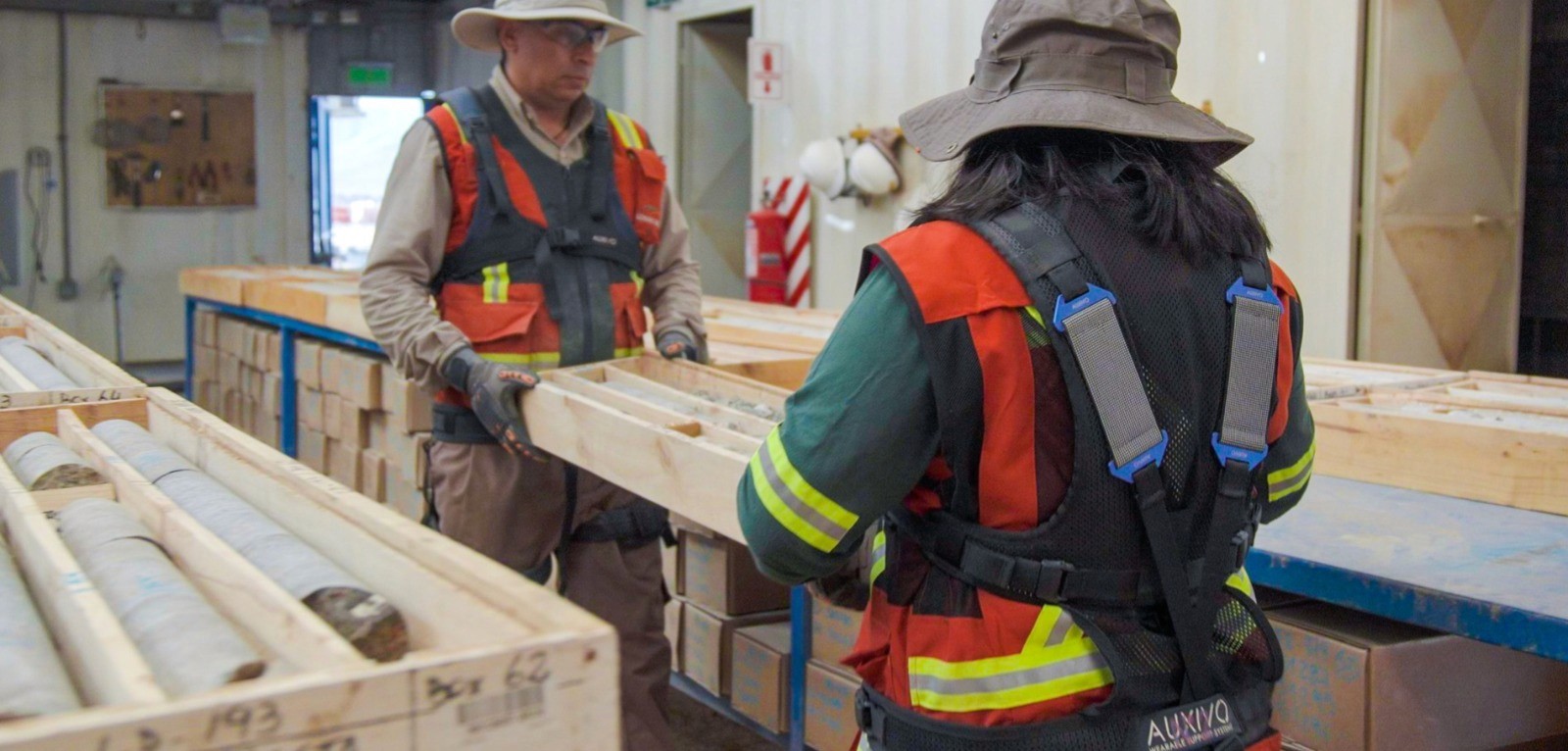
Reduce fatigue and MSDs in mining environments with the LiftSuit, a lightweight lumbar exoskeleton that reduces back effort by up to 33%.